Jho Institute for Minimally Invasive Neurosurgery Department of Neuroendoscopy

Spine Diseases
 Cervical disc
 Brain Diseases
Directions to the JHO Institute for Minimally Invasive Neurosurgery, Department of Neuroendoscopy
For referral information or appointment for consultation contact
Address : JHO Institute for Minimally Invasive Neurosurgery
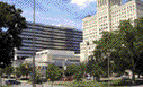
 Department of Neuroendoscopy Department of NeuroendoscopySixth Floor, South Tower
Allegheny General Hospital
320 East North Avenue
Pittsburgh, PA 15212-4772
 For referral information or appointment for consultation contact: For referral information or appointment for consultation contact: Practice Manager: Robin A. Coret
 Tel : (412) 359-6110
Fax : (412) 359-8339
|
Directions / Hotels-Should you decide to use a GPS device, please consider searching for "Allegheny General Hospital" itself and not simply the address of 320 East North Avenue.
Some GPS devices do not recognize the address. Once at the hospital, follow signs to the James Street or Sandusky Parking options.
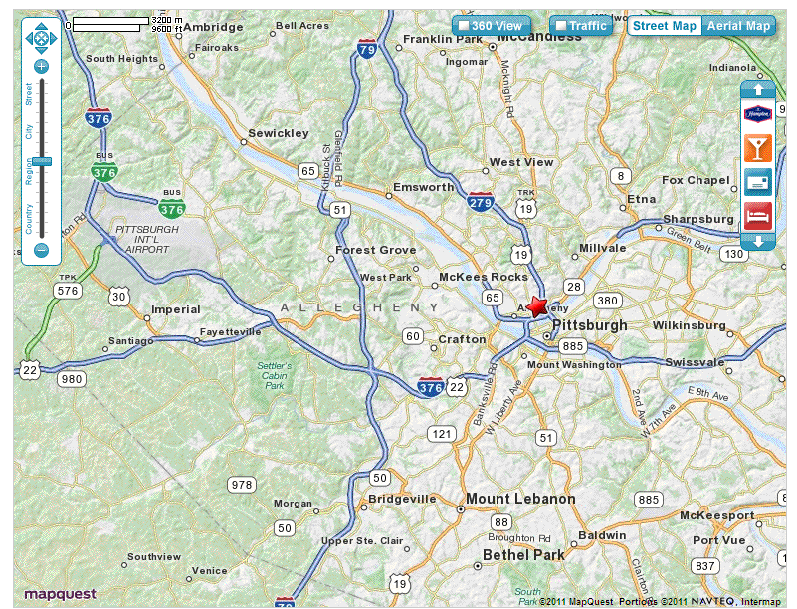
Overview Map Showing Airport Location
Directions
From the Pittsburgh International Airport (and From I-79 South)
 Follow Route 60 South to I-376 East (formerly I-279 North) (no turns, only name change). Take I-376 East (formerly I-279 North) through the Fort Pitt Tunnel and across Fort Pitt Bridge. Take Exit 70C (I-279 North) and proceed across the Fort Duquesne Bridge. Bearing right, remain on I-279 North. Take the East Ohio Street Exit (Exit 1D). Stay in the left lane and take
 the East Ohio Street Exit ramp.
At the first traffic light, turn left onto East Ohio Street. Proceed through the East Ohio Street business district to James Street.Turn right onto James Street. Follow James Street through three stop signs and one traffic light. Turn left into the James Street parking garage. From Pittsburgh / Monroeville Exit-(Exit 57) on Pennsylvania Turnpike (I-76)
Take I-376 West (toward Pittsburgh and airport) to the I-279 North / North Shore Exit. Proceed across the Fort Duquesne Bridge. Bearing right, take the I-279 North ramp. Take the East Ohio Street Exit (Exit 1D). Stay in the left lane and take the East Ohio Street Exit ramp.
At the first traffic light, turn left onto East Ohio Street. Proceed through the East Ohio Street business district to James Street. Turn right onto James Street. Follow James Street through three stop signs and one traffic light.Turn left into the James Street parking garage.From Route 28 North /Allegheny Valley Exit-(Exit 48) on Pennsylvania Turnpike (I-76)
NOTE: EXPECT CONSTRUCTION DELAYS ALONG ROUTE 28 UNTIL YEAR 2014
Follow Route 28 South to East Ohio Street.Bear right at the sign marked East Ohio Street / I-279. Follow the signs to East Ohio Street.
Continue straight through three traffic lights into the East Ohio Street business district. Turn right onto James Street. Follow James Street through three stop signs and one traffic light. Turn left into the James Street parking garage. From I-79 / Erie / Butler County / Cranberry Exit - (Exit 28) on Pennsylvania Turnpike (I-76)
Take I-79 South to the I-279 South Exit. Follow I-279 South to the East Street exit (Exit 2B / 28 North). Proceed through the stop sign. At the first traffic light, turn right onto North Avenue. At the next traffic light, turn right onto James Street and left into the parking garage. Parking
James Street Parking Garage - SELF PARK
Take James Street elevators to First Floor (Floor 1, not 1A), follow hallway straight through revolving door, past Volunteer Office, past Drexel University Office to main hallway.Make a LEFT, following arrows to the "B" (Green) elevator within the South Tower.Take the "B" elevator to the 6th Floor - Note: Elevators are located on both sides of the hallway.Enter through the double doors across from Pediatrics Office.Sandusky Street Parking - Note: VALET PARKING (Do not park in “Outpatient Surgery Lot?
Sandusky Valet Parking is located on Sandusky Street side of HospitalOnce inside Hospital, follow signs to "B" (Green) Elevator in South Tower. - Note: Elevators are located on both sides of the hallway. Enter through the double doors across from Pediatrics Office.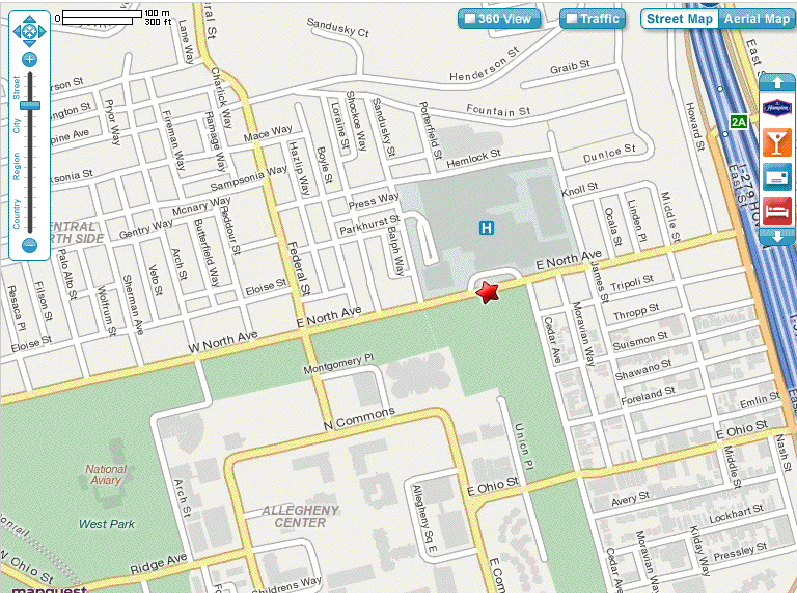
Detail Map
Hotel Information
North Shore/North Side Hotels
|
Downtown Hotels
|
Springhill Suites - North Shore
223 Federal Street, Pittsburgh, PA 15212
Phone: 412-323-9005 Fax: 412-323-9555
Shuttle Service Available to the Hospital
(Within 1 mile of Allegheny General Hospital)
Residence Inn Pittsburgh - North Shore
574 W. General Robinson St, Pittsburgh, PA 15212
Phone: 412-321-2099
Recommended for Longer Stays
(Within 1 mile of Allegheny general Hospital)
Hyatt Place Pittsburgh - North Shore
260 North Shore Drive, Pittsburgh, PA 15212
Phone: 412-321-3000 Fax: 412-321-3300
(Within 1 mile of Allegheny General Hospital)
www.hyatt.com-Special Rate
 The Priory Hotel - North Side The Priory Hotel - North Side614 Pressley Street, Pittsburgh, PA 15212
Phone: 412-231-3338 Toll Free: 866-3PRIORY
(Within 0.5 miles of Allegheny General Hospital)
Also, check out www.wpahs.org for a list of more hotels that may have deals if you are using WPAHS facilities.
|
Renaissance Pittsburgh Hotel
107 6th Street, Pittsburgh, PA 15222
Phone: (412) 562-1200 Fax: (412) 992-2010
Toll Free: 1-866-454-4400, International: 1-800-468-3571
(Within 1.23 miles of Allegheny General Hospital)
Marriott Courtyard Pittsburgh Downtown
945 Penn Avenue, Pittsburgh, PA 15222
Phone: 412-434-5551 Fax: 1-412-434-5552
Shuttle Service Available to the Hospital
(Within 1.5 miles of Allegheny General Hospital)
Wyndham Grand Pittsburgh Downtown
600 Commonwealth Place, Pittsburgh, PA 15222
Phone: 877-999-3223 or 412-391-4600
Shuttle Service Available to the Hospital
(Within 1.4 miles of Allegheny General Hospital)
www.wyndhamgrandpittsburgh.com - Special Rate
Fairmont - Pittsburgh
510 Market Street, Pittsburgh, PA 15222
Phone: 412-773-8800, International: 800 0441 1414
Toll Free: 1-888-270-6647 - Also See Website
(Within 1 mile of Allegheny General Hospital)
|
Other Hotels
Hampton Inn Pittsburgh/Green Tree
555 Trumbull Drive, Pittsburgh, PA 15205
Phone: (412) 922-0100 Fax: (412) 921-7631
Toll Free Reservations: 1 (800) HAMPTON (800-426-7866) - Ask about "We Care Rate"?/B>
Shuttle Service Available to the Hospital
(Within 5.42 miles of Allegheny General Hospital)
|
|
Local Activities
The Andy Warhol Museum - North Side
The Carnegie Science Center - North Shore
The Children's Museum - North Side
The National Aviary - North Side
 Pittsburgh Zoo & Aquarium-Highland Park Pittsburgh Zoo & Aquarium-Highland Park The Rivers Casino - North Shore The Rivers Casino - North Shore |
Pittsburgh Pirates (in season) - North Shore
PNC Park - For Tickets: www.pirates.com
Pittsburgh Cultural Trust - Downtown
Theater and Music - www.pgharts.org
 Heinz History Center -http://www.heinzhistorycenter.org/ Heinz History Center -http://www.heinzhistorycenter.org/ Gateway Clipper Fleet - Station Square Gateway Clipper Fleet - Station SquareCruise the Three Rivers- www.gatewayclipper.com
 Ducky Tour - (in season) - Station Square Ducky Tour - (in season) - Station SquarePittsburgh Tour on Land & Sea
www.justduckytours.com - (in season)
|